

Earthquakes causes the ground to shake, and occur when there is a sudden movement in the Earth’s crust. They happen in areas where two of the Earth’s plates meet under the ground
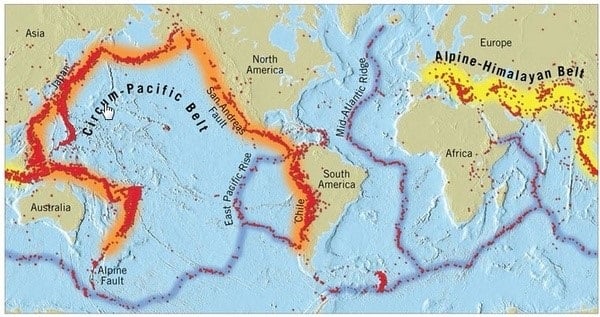
earthquake areas
Most earthquakes occur around the edges of the Pacific Ocean or in mountainous areas such as the Himalayas. It is here that the plates under the Earth’s surface are pushing or sliding the most. Scientist monitor these areas to try to predict earthquakes, measuring for possible warning signs- such as minor tremors that might build up to a larger event.
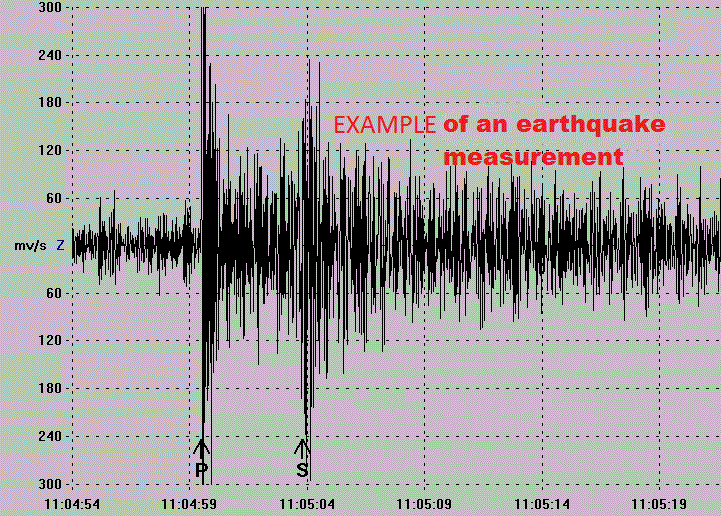
measuring earthquakes
Instruments called seismographs measure earthquakes. A seismograph detects the shock waves produced and displays a line that records how strong each wave is.
FACTS…FACTS…FACTS!!!
The Richter Scale has 10 numbers representing the energy produced by an earthquake. Each number represent 10 times more energy than the previous number.
| SCALE | EFFECTS | FREQUENCY |
| 0 – 2.0 | Not Felt | 8 000 a day approx. |
| 2.0 – 2.9 | Not felt but recorded | 1 000 a day approx. |
| 3.0 – 3.9 | Felt but no damage | 49 000 a year approx. |
| 4.0 – 4.9 | Felt slightly indoors | 6 200 a year approx. |
| 5.0 – 5.9 | Weak buildings might fall | 800 a year approx. |
| 6.0 – 6.9 | Destructive up to 160km away | 120 a year approx. |
| 7.0 – 7.9 | Severe damage in large area | 18 a year approx. |
| 8.0 – 8.9 | Severe damage over 1 000km | 1 a year approx. |
| 9.0 – 9.9 | Devastation up to 10 000km | 1 in 120 years approx. |
| 10 | Has never been recorded |
 Know It All and Everything